The Civil Defence Corps, a civilian volunteer organisation, was established within Great Britain during 1949. It was stood down within Great Britain in1968. Civil Defence Corps still exist today in the Isle of Man, Republic of Ireland and many other countries such as Australia, New Zealand and Iceland.
Introduction
The Isle of Man Civil Defence Corps (IoM Civil Defence) is overseen by Ian Young, Emergency Planning Co-ordinator within the Isle of Man Government Department of Home Affairs.IoM Civil Defence provides The Emergency Planning Unit with initial support for setting up and running an Emergency Control Centre to facilitate Government’s coordinating role in the management of an emergency.
The full establishment of IoM Civil Defence is 50 members. When vacancies arise membership is open to anybody aged between the age of 18 and 65 years of age who is physically fit, honest, reliable and enjoys working as part of team.
Volunteers provide support in a variety of emergency situations, working alongside other frontline agencies such as the Constabulary, Fire & Rescue Service, Ambulance and Coastguard to help maintain community safety.The Isle of Man has a fine tradition of looking after people in their time of need and IoM Civil Defence is an important part of the resilience that allows us to prepare for and respond to emergencies, whatever the scale.
IoM Civil Defence is a special organisation – like an insurance policy, you hope you’ll never need it, but if things go wrong you know the members will be there to help.
What we do :
A Volunteer’s Role :
Weekly training is undertaken to equip new and existing recruits with the necessary skills to
undertake the following duties:
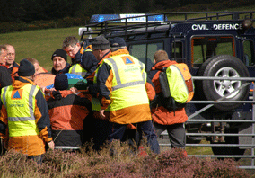
Hill Search& Rescue:
Members are well versed in map-reading and navigation skills including use
of a compass, hand held GPS navigation systems, and recognised search and
rescue techniques.Civil Defence form part of the Inland Search and Rescue Team, and they exercise regularly with the other services involved.
One of the last major joint exercises took place during September 2010. The Exercise -
Operation Theseus - involved about 70 Police, Fire, Coastguard and Civil
Defence staff and was staged at the Windy Corner area of the Mountain Road.
The exercise involved a search for injured persons missing from a car crash and was designed
to test different elements of our joint capability.
Civil Defence Teams regularly exercise at least once a month, throughout the year, during the
hours of darkness, so they are well practiced and maintain the capability of
operating on the hills in the harshest of winter conditions throughout the
night.
If you do go out walking make sure your friends and family know where you and your
companions are going and take some form of communication with you. A personal
knowledge of map reading would be beneficial in the event of sudden low cloud
and foggy conditions. Satellite navigation software now comes readily available
on most modern mobile phones. Ensure that you wear suitable clothing and
footwear, take with you something bright or hi-visibility for emergency, and
carry fluids and food as required for your journey.
First Aid:
Members possess
a three year qualification in Public First Aid or First Aid at Work
certification and undergo regular validation of CPR techniques and use of
modern Heart Start equipment. A range of
stretchers are available should a member of the public require assistance after
an incident.
IoM Civil Defence currently provides support to a number of local community events such
as the Manx Mountain Marathon, The Parish Walk and The End to End Walk.
Driving:
Members should possess a full clean driving licence which will allow them to train further and
gain a qualification as a MIDAS or HGV driver (MIDAS certification allows the
holder to drive minibuses with up to a max of 16 passengers onboard).
The IoM CivilDefence has a range of vehicles which include trailers for moving lighting
equipment and air tents, a catering trailer and control units for use during
events and emergencies, nine minibuses and three 4 Wheel Drive (4WD) vehicles.
Basicmechanical and safety awareness training for the vehicles and trailers is
given. Drivers also now undertake additional training in off-road driving of
4WD vehicles to assist with extreme weather conditions (such as the recent
snowfalls). During December 2010 the IoM Civil Defence were able to support
Nobles Hospital staff, patients and members of the public living in remote
areas of the Island. Members provided vehicular support to help with the
collection and delivery of medical prescriptions and transportation of staff to
and from shifts at Nobles Hospital The Hospice Isle of Man, and other strategic
areas such as Nursing Homes.
Communications:
IoM Civil Defence use the all Island Terrestrial Trunked Radio (TETRA) System managed by
the Emergency Services Joint Control Room. This system was launched to all of
the Emergency Services in April 2004 and there are now 21 groups who use it
which include Police, Fire, Ambulance, TT marshals, various Government
Departments and Statutory Boards.
All Tetra communication within IoM Civil Defence is logged and when Civil Defence are
operational they maintain a stand alone Control Centre which works closely with
ESJCR.
Generators & Lighting:
Training is undertaken in the safe and efficient operation and maintenance
of electrically generated lighting. Portable lighting can be deployed to light
up specific areas during an emergency.
The Post Office benefitted greatly from this during the Christmas Period when large containers
arrived full of post and no outside lighting was available to use when the post
was unloaded late at night. Lighting has also been provided at public events,
when organizers lighting has failed.
Evacuation,Welfare & Rest Centres:
IoM Civil Defence is responsible for setting up andrunning Evacuation Centres in terms of the Government Emergency Plans. Theywork and train with Social Services. Regular Rest Centre exercises supported by
Social Services and The Women’s Institute regularly take place in the North,
South, East and West of the Island to test the initial response in respect of
an evacuation and to practice the necessary administration processes required
as part of an emergency situation.
Flood Response:All members are
trained in basic domestic salvage techniques, the safe use and maintenance of
water pump equipment and the use of sandbags.
During high tides and severe weather IoM Civil Defence works alongside other emergency
services and local authorities to alleviate the effects of flooding.
Emergency Catering:
Members are trained in the setting up and operation of Emergency Feeding Centres and the
rapid provision of hot drinks and light meals at any location. All IoM Civil
Defence members involved in such activities undertake a basic food handling and
hygiene course. Regular catering assistance is supplied to the other emergency
services during long call outs such as fires and police investigations.
Regular ‘Curry Night’ events have been successfully organised to raise funds annually for the
Army Benevolent Fund Charity.
Chemical, Biological, Radiological & Nuclear (CBRN) Monitoring:
While some aspects of terrorist risks can be handled by existing "all hazards"
emergency planning, it is clear that many of the threats now considered to be
plausible, although the treat on the Island is considered very low, require
specific precautions to be in place, and these new plans be fully integrated
with existing planning arrangements.
A wide range of possible biological, chemical or nuclear agents could be used for terrorist
purposes. It is prudent that contingencies be put in place in order to minimise the effects of such
incidents. These contingencies broadly consist of comprehensive plans for
handling an incident, the availability of specialist items of equipment and
supplies for emergency use, and the training of key personnel in likely scenarios
and use of emergency equipment. Selected members are trained to support other
emergency services if necessary for mass decontamination and other situations.
Official Functions, Processions & Parades:A Standard Bearer holding a staff displaying the Civil
Defence Flag leads volunteers participating in regular processions and parades
on and off Island throughout each year. Previous parades have included Armed
Forces Day, Tynwald Day and Remembrance Sunday.
During 2010 IoM Civil Defence Volunteers worked a total of 4,600 man hours to assist in keeping our Island a safe place to live.